
Alata
Alice
Open Sans
Noto Sans
Bebas Neue
Great Vibes
Rock Salt
Exo
Belgrano
Overlock
Cinzel
Indie Flower
Staatliches
Roboto Slab
Lato
Noto Serif
Open Sans
Montserrat
Ubuntu
Rubik
Delius
Amiri
Montserrat
Trusted Partners in Care Transitions
Expertise Across the Care Continuum
Our providers bring extensive experience across all levels of medical care—from acute hospital and inpatient rehabilitation to skilled nursing, assisted living, long-term care, and hospice and palliative services.
Coordinated Transitions for Better Outcomes
We guide patients through every transition in their health journey, managing medical needs proactively to support safety, stability, and the best possible outcomes.
Communication That Strengthens Care
By collaborating closely with referring physicians, primary care providers, and specialists—and providing timely updates to families—we ensure continuity, clarity, and compassionate support.
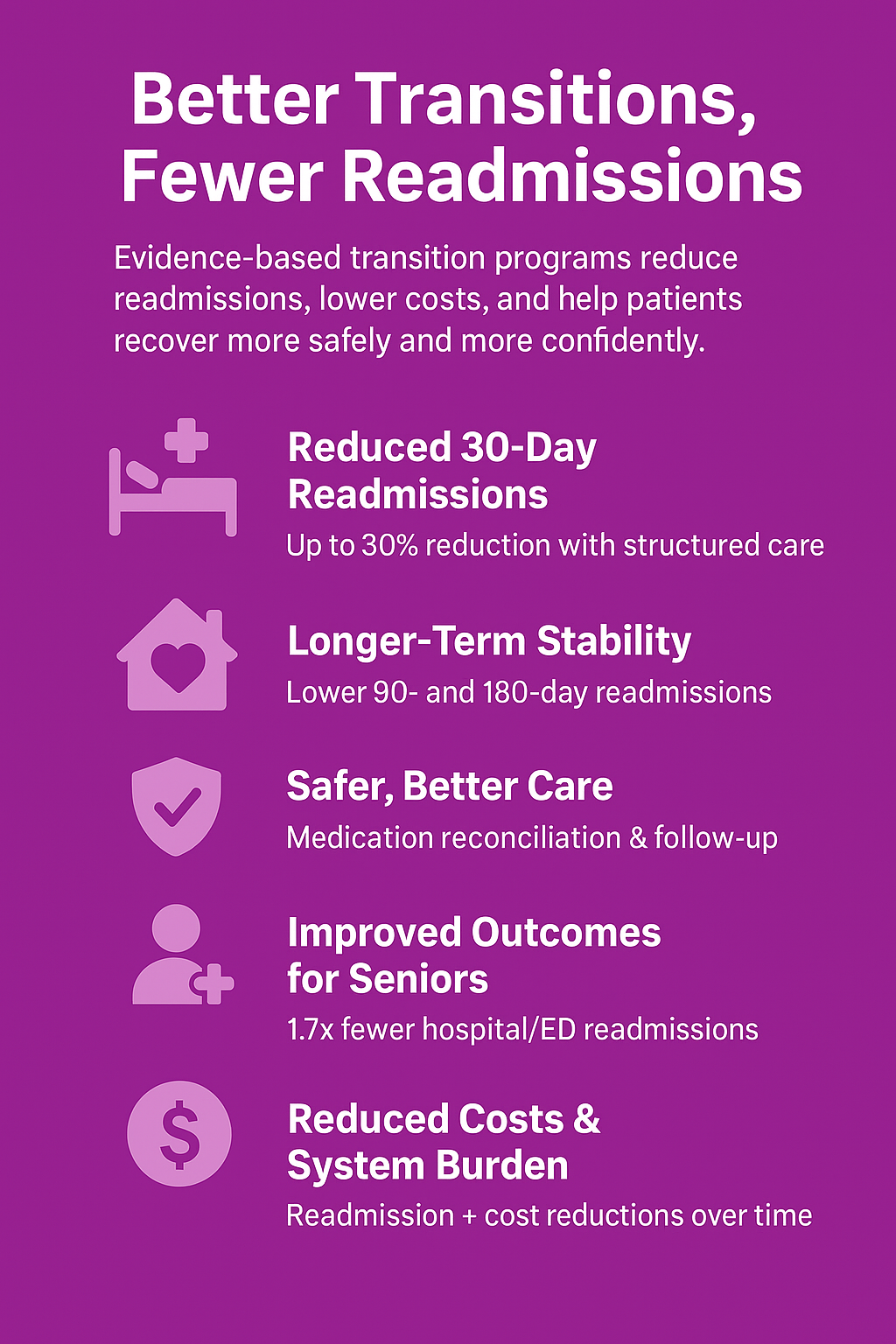
References Used in the Infographic Above:
- JAMA Internal Medicine (2016) Transitional care interventions and structured discharge programs have been associated with significant reductions in 30-day hospital readmissions. JAMA Intern Med. 016;174(7):1035–1107.
- JAMA Network Open (2025) Multi-component transitional care interventions have been shown to reduce 90- and 180-day readmissions. JAMA Netw Open. 2025;662347816.
- Journal of Hospital Medicine (2007) Medication reconciliation and coordinated follow-up improve safety and reduce care transition–related complications. J Hosp Med. 2007;2(6):314–322.
- Journal of General Internal Medicine (2013) Readmission reduction and cost benefits associated with transitional care programs. J Gen Intern Med. 2013;34(19):1739–1760.
- The Commonwealth Fund (2019) Transitional care models improve outcomes and reduce hospital/ED utilization among older adults. The Commonwealth Fund. 2019.


Why Safe Transitions Matter
Moving from one care setting to another can be challenging, but strong coordination makes a meaningful difference. Data from CMS’s Community-based Care Transitions Program (CCTP) shows that structured support reduced 30-day readmissions by up to 20%. (pubmed.ncbi.nlm.nih.gov) This highlights how thoughtful planning and clear communication help patients stay healthier after leaving the hospital.
Support at Every Step
CMS also stresses the importance of seamless information exchange and personalized discharge plans, ensuring that medical details and preferences follow patients across providers. (cms.gov) With our team’s extensive experience guiding patients and families through the continuum of care, transitions are handled with compassion and clarity—reducing complications, supporting recovery, and bringing peace of mind during stressful moments.